The Cognitive Abilities Test (CAT4) is an assessment designed to help students and their teachers understand how they learn and what their academic potential might be. It assesses how students think in areas that are known to make a difference to learning.
CAT4 is designed to give schools a much broader, more rounded view of each child, their potential and how they learn. Results help teachers decide about the pace of learning that is right for a student and whether additional support or challenge is needed.
Tasks involve thinking about shapes and patterns (Non-Verbal Reasoning), words (Verbal Reasoning), numbers (Quantitative Reasoning) and some questions are answered by mentally generating and transforming visual images (Spatial Ability).
CAT4 is based on years of research and development. The current edition took five years to develop and involves testing and standardising students across the UK and Ireland. Teachers value its ability to provide an understanding of what a child is capable of, rather than defining them by their understanding of a body of knowledge in particular subjects.
CAT4 provides teachers with information that can form the basis for discussions about how best a student can learn and reach their potential in school.
Teachers are provided with an individual profile of learning preference along with a range of indicators of likely future performance. Used with other information, these data can support teaching and learning for all children.
CAT4 is a timed assessment and is administered under formal conditions. However, each section of the assessment includes introductory information with practice examples which will familiarise students with the style and format of the questions. These introductory sections are not timed and may be repeated.
We strongly advise against any kind of practice ahead of a CAT4 test as this will alter the reliability of test scores. The point of CAT4 is that it is not a test of learnt knowledge and it needs to be as unaffected as possible by any external factors, such as practice.
Think of it like an eye test — if you practise ahead of an eye test and memorise the card, your diagnosis may not be correct and valuable information may be missed.
You will receive an individualised summary of the student’s learning and performance on the CAT4 assessment. This is to help you understand your child better and support them in their future studies.
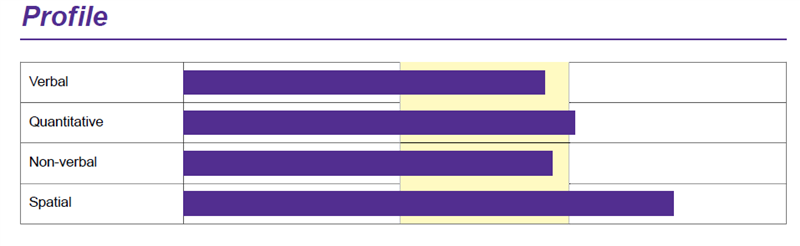
Yellow bars — average performance for this age group
Purple bars — your child’s individual results
The bar chart under ‘Profile’ shows attainment in each of the 4 areas. To the left of yellow = below average; to the right = above average. Underneath the bar chart there is a detailed written summary of your child’s strengths and performance.
Parents should read this and consider how best they can support or advise their child during homework and study sessions. This can also inform discussions about subject options for Senior Cycle as it can show where the strengths lie for the student.
CAT4 consists of four test batteries, each of which contains two tests for all but the youngest children. These batteries and tests are described below.
Each question presents three words that are all similar in some way. Students identify the conceptual link between the three words and select from five further words the one that best fits with the first three. Assesses general verbal reasoning, general knowledge, word knowledge and language development.

Each question presents a verbal analogy in the form of ‘A–B : C–_’. Students work out how the first pair of words is related and select from five answer options the one that completes the second pair. Questions are written to maximise flexibility in identifying and using concepts rather than taxing background knowledge or vocabulary.

Each question presents three pairs of numbers, such as ‘4–6, 8–10, 9–_’. Students work out how the pairs of numbers are related and complete the third pair by selecting the answer from five options. Assesses basic reasoning processes, arithmetic knowledge and flexibility in identifying numerical relationships.

Students work out the rule underlying the progression in a number series and select the next number in the series from five options presented. Assesses the same underlying basic reasoning processes and number facility as Number Analogies.

Each question presents students with three separate figures. They identify the conceptual link or underlying characteristic that all three figures have in common, then select the one figure from five answer options that goes with the first three. Assesses the ability to identify similarities, differences and relationships between elements. No words or numbers are used.
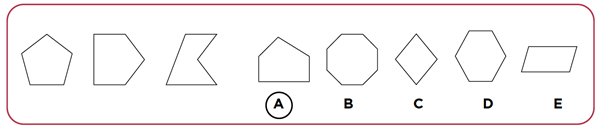
Each question presents a figural analogy in the form of ‘A–B, C–_’. Students work out how the first pair of figures is related and select from five answer options the one that completes the second pair. The tests emphasise the discovery of, and flexibility in, manipulating relationships expressed in figural designs.

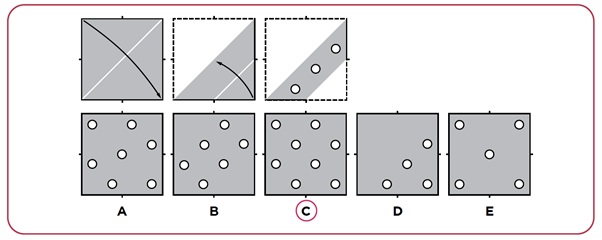
Each question presents a square that is repeatedly folded and then has one or more holes punched through it. Students work out what the final product would look like when unfolded and select this from five answer options. Assesses visualisation processes — the ability to create a complex mental image, retain it in mind and manipulate it.
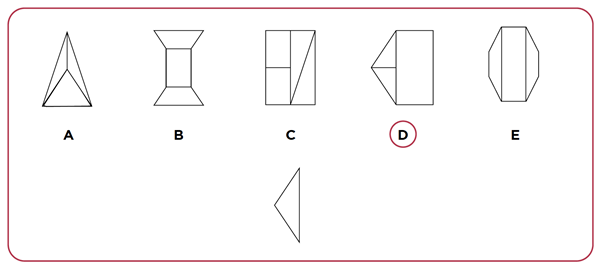
Students are shown five complex designs as line drawings with a target shape below. They identify which of the five designs contains the exact same size outline of the target, including each side in full. Assesses visualisation skills — particularly the ability to create and retain a firm mental image of a shape that represents angles and lengths accurately.